


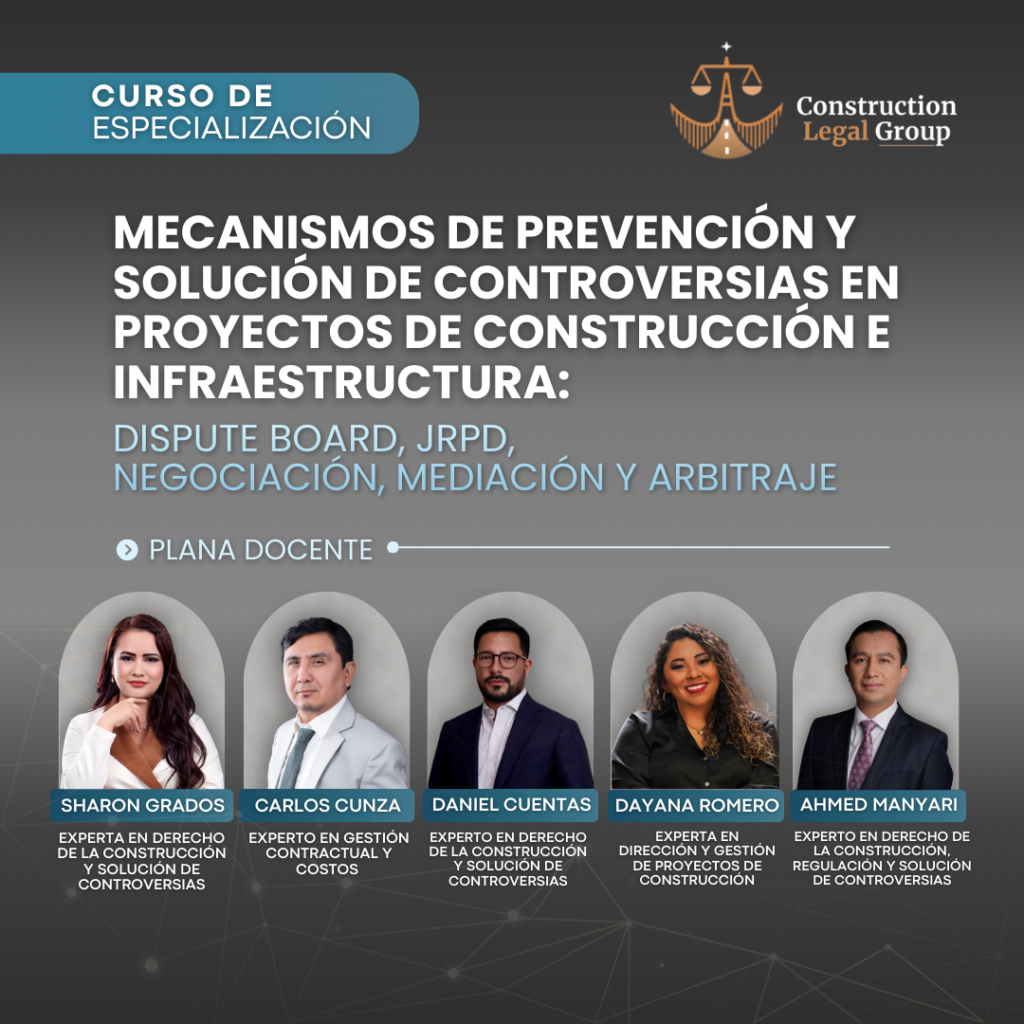
MECHANISMS FOR PREVENTING AND RESOLVING DISPUTES IN CONSTRUCTION AND INFRASTRUCTURE PROJECTS
General information:
Duration: 22 teaching hours
Start: April 13
Schedules: 8:00 pm to 10:00 pm
Modalidad: Sincrónica (clases en vivo)
Docentes:
Dr. Sharon Grados
Expert in construction law, contract law, and dispute prevention and resolution mechanisms. Arbitrator and Founding Partner of CLG.
Expert in contract management and costs for large-scale projects. Managing Partner of CLG, Civil Engineer (UNI), MBA.
Expert in arbitration, negotiation, and dispute resolution in construction projects and public procurement. Arbitrator and member of the Chartered Institute of Arbitrators (CIArb).
MBA. DAYANA ROMERO
Expert in project management and control, PMO, risk and schedule management in infrastructure projects. Civil Engineer and MBA in Project Management.
MG. AHMED MANYARI
Expert in construction law and dispute resolution in infrastructure projects. Arbitrator, member of Dispute Boards, and consultant to the World Bank.
Description
About the course
The specialized course in Mechanisms for the Prevention and Resolution of Disputes in Construction and Infrastructure Projects It offers a comprehensive, structured and strategic view of the main mechanisms used in the industry to prevent, manage and resolve contractual disputes.
Throughout the program, the following are analyzed: Dispute Boards (DB) and the Dispute Prevention and Resolution Board (DPRB), developing its conceptual and regulatory framework, its operation in standardized contracts and in the Peruvian regime, as well as the proper deployment of its preventive, consultative and decisional functions, and its interaction with arbitration.
The course also covers the mediation and the negotiation as strategic tools for conflict management in construction projects, developing their methodologies, structural approaches, strategies and practical application in complex technical contexts, whose proper use is essential in an industry historically marked by high levels of conflict.
The program culminates with a specialized analysis of construction arbitration, including precautionary measures, emergency arbitration, technical expert reports and the recurring problems faced by the parties in this type of dispute.
The approach is eminently practical and strategic: it does not limit itself to explaining the mechanisms, but analyzes how to use them effectively at each stage of the project to strengthen contract management, minimize conflict, optimize decision-making and escalate only those disputes whose complexity or economic and/or legal impact justifies their submission to arbitration.
Aim
To develop in the participants a comprehensive and strategic understanding of the mechanisms for preventing and resolving disputes in construction and infrastructure projects, strengthening their capabilities to prevent and manage contractual disputes efficiently, select the appropriate mechanism according to the stage of the project and design strategies that allow to preserve contractual balance and project continuity, as well as optimizing the decision making.
The course aims to ensure that participants not only understand how the... Dispute Boards (DB), the JConflict Prevention and Resolution Board (JPRD), the mediation, the negotiation and the arbitration, but rather acquire practical tools and criteria to use them appropriately, to prevent the unnecessary escalation of controversies and to properly address those disputes that require formal resolution.
Syllabus
- SESSION – 1: Dispute Boards in Construction Contracts (Part 1)
- Preliminary aspects: definition, characteristics and types of DB
- Dispute Boards in Standardized Construction Contracts
- SESSION – 2: Dispute Boards in Construction Contracts (Part 2)
- The Dispute Board in the ICC Rules
- Preventive and consultative function: Guidelines, consultations and recommendations
- Decision-making function: Formal submission, procedure and decision.
- SESSION – 3: Conflict Prevention and Resolution Board (CPRB) (Part 1)
- La JPRD en el Perú: definición y marco contractual-legal
- Constitución, organización y competencias de la JPRD
- SESSION – 4: Conflict Prevention and Resolution Board (CPRB) (Part 2)
- Procedure before the JPRD: technical and contractual management
- JPRD decisions: effects and subsequent strategy
- SESSION – 5: Mediation (Part 1)
- Key aspects
- The mediator
- Mediation clause in construction contracts
- SESSION – 6: Mediation (Part 2)
- Methodology and procedure of mediation: Preparation, initiation, exploration, interests vs. positions. Negotiation, agreement and closure.
- Mediation and differences with other figures.
- SESSION – 7: Negotiation (Part 1)
- What is negotiation and how is it applied in construction projects?
- Structural approaches to negotiation:
- Distributive vs. integrative negotiation
- Negotiation based on the Harvard Model
- Strategic risk assessment in infrastructure
- SESSION – 8: Negotiation (Part 2)
- Direct negotiation procedure (Preparation, opening, exploration, proposals and concessions, closing)
- Strategy and tactics at the negotiating table
- SESSION – 9: Negotiation (Part 3) / Construction Arbitration (Part 1)
- Differentiated recommendations according to the project stage (contract execution, direct negotiation, mediation and within arbitration)
- Preliminary aspects of arbitration
- Characteristics of arbitration in the construction sector
- SESSION – 10: Construction Arbitration (Part 2)
- Interaction between DB/JPRD and arbitration: legal and procedural effects
- Emergency arbitration in construction
- Precautionary measures in construction arbitration
- SESSION – 11: Construction Arbitration (Part 3)
- Expert reports in construction arbitration
- Recurring problems in construction arbitrations
Teachers
Dr. Sharon Grados
Arbitrator, Consultant and Founding Partner of Construction Legal Group (CLG). Lawyer from the National University Federico Villarreal, with a Master's degree in Civil and Commercial Law from UNMSM, as well as postgraduate studies in Construction Law, Tort Law, Public Procurement, PPPs, Project Management and Dispute Resolution.
His career encompasses extensive experience in contract design and negotiation, contract execution, claims management and dispute resolution in large-scale infrastructure projects, both nationally and internationally.
She also works as a trainer in public and private institutions. She is a member of the Society of Construction Law UK and the Peruvian Society of Construction Law.
ENG. CARLOS CUNZA
Managing Partner of Construction Legal Group (CLG). Civil Engineer from the National University of Engineering (UNI), with a Master of Business Administration (MBA) from Centrum PUCP. Specializing in contract management, costs, planning, risks, and disputes in infrastructure projects, he has over 15 years of experience in large-scale projects, particularly in sanitation works (wastewater treatment plants, drinking water and sewage lines and networks) and roads.
He has held key roles such as Contract Administrator, Planning and Cost Specialist, and Technical Office and Valuation Engineer, participating in top-level companies and consortia such as COSAPI, SADE-COSAPI, Constructora MPM, Consorcio Sullabella, Consorcio PTAP Calana, among others, where he has demonstrated analytical and managerial capacity in the management of public works.
ATTORNEY DANIEL CUENTAS

He is an arbitrator and a member of the Chartered Institute of Arbitrators, registered with the National Registry of Arbitrators of the OSCE (Organization for Security and Co-operation in Europe). He holds a law degree from UPC (Universidad Politécnica del Perú) and has extensive experience in arbitration, as well as recognized expertise in various areas, including construction law, government contracts, and property law. He has served as arbitration secretary at the Arbitration Center of the Lima Chamber of Commerce, where he participated in cases covering diverse legal issues, both in domestic and international arbitrations.
He also specializes in negotiation and mediation, and is registered with the International Mediation Center. In his academic career, he served as Latin American ambassador for Arbitrator Intelligence (an initiative founded by Professor Catherine Rogers), was selected as an arbitrator for the Rising Arbitrators Initiative, is a member of the Instruments and Events Committee of the Peruvian Chapter of the International Chamber of Commerce (ICC), and is a coach in arbitration competitions.
MBA. DAYANA ROMERO
A Civil Engineer with an MBA in Project Management, she holds PMP®, PMI-RMP®, PMI-SP®, PMI-PMOCP®, and PMI-CP® certifications, which support her specialization in project management, risk, schedule, PMO, and construction management. She also holds dual certifications in Project Planning & Control (PPC) Foundation and Practitioner, ISO 21500 and ISO 31000, and the Inter-American Development Bank's (IDB) PM4R® Professional and PM4R® Agile credentials.
He has over 16 years of experience in PMO, Project Management, Programs and Portfolios, as well as Project Control in sectors such as mining, infrastructure, energy, buildings and the public sector.
Its area of specialization integrates governance and design and implementation of PMO, strategic management of projects and programs, portfolio management and project control (schedule, costs, risks and reporting), oriented towards decision-making and strategic organizational alignment.
She currently serves as CEO and Principal Consultant at Dayana Romero Institute & Consulting, leading executive training programs and implementing methodologies for public and private organizations in Peru and Latin America.
MG. AHMED MANYARI
Arbitrator and member of Dispute Boards (including Dispute Prevention and Resolution Boards – DPRBs) in public and private infrastructure projects. Specialist in construction law, regulation, and dispute resolution. He is a consultant for the World Bank and has advised public and private entities at all stages of infrastructure projects.
He has been an associate lawyer at the firms Campos / Arbitration and Infrastructure (CAI) and Bullard Falla & Ezcurra (BFE+).
Master of Laws from the Pontifical Catholic University of Peru, with training in Construction Project Management. Bachelor of Education from Cayetano Heredia University. He teaches in postgraduate programs at CENTRUM PUCP, UPC, and other institutions. He is a member of the Board of Directors of the Peruvian Society of Construction Law.